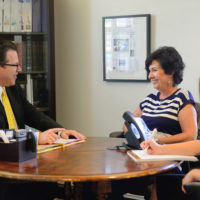
South Florida Grass-roots Group Pushes For Guardianship Reform
Dr. Robert Sarhan watched in a court as his mother, Yvonne, pleaded a decade ago with a Miami-Dade probate judge to name him as her guardian.
After all, he was a doctor with the U.S. Bureau of Prisons and a beloved son. Who better to take care of his mother?
But citing discord between Sarhan and his brother, Circuit Judge D. Bruce Levy appointed a professional guardian. An attorney was brought into the case, and the attorney brought in scores of other professionals, including around-the-clock nurses and maids, Sarhan said.
“All of the sudden my mother was treated like an invalid, but she wasn’t. She was fully competent,” he said. “This is the modus operandi: isolate, medicate and then steal from the estate.”
Attorney Robert L. Moore of Miami said he has assisted Sarhan and others pro bono in fighting unjust guardianships.
“I think Florida has a real big problem on it’s hands, and I am not sure if the state really knows what to do,” Moore said.
“There is clearly an effort or movement afoot of those who have had loved ones taken away from them and their inheritance squandered by predatory, shark-like attorneys who see this as a legitimate form of business.”
Yvonne Sarhan died in 2010 after her son spent every cent he had fighting to retain guardianship. Dr. Sarhan has since joined about a dozen other South Floridians who say it’s time for the Florida Legislature to step in and update guardianship laws.
‘No Oversight’
The group of emotionally drained people with guardianship complaints is motivated but frightened.
One woman in this group appeared on a Miami radio show in May to tell her story about how a guardianship did not provide one cent for her mothers care while attorneys charged hundreds of thousands of dollars in fees to her mother’s account.
She is lobbying lawmakers in Florida and Washington but does not want her name published after she asserted she received threats from guardians and their lawyers that it would be wise to remain silent.
“There is no oversight in this area of the law. Meanwhile, more people require guardianships on an annual basis,” she wrote in a letter to the U.S. House, “Instead of the elderly being protected, they are being subjected to humiliating and degrading treatment whereby their funds are used to first pay attorneys involved in their cases.”
She is proposing reforms to Florida Statute 744, the state guardianship law, that would include a court monitoring system for guardians to prevent looting, a cap on attorney fees, a new standard for finding a person incapacitated and placing lay people on The Florida Bar Probate Rules Committee.
Members of the group have similar stories. Some say their loved ones set up living trusts indicating who they want to take care of them only to have their plans erased with a stroke of a judge’s pen.
State Senator Gwen Margolis, D-Miami, has taken an interest in the issue.
“I have heard some horror stories about people who lose their rights to be with or take care of their parents once a guardian gets involved,” Margolis said.
“While I believe that most guardians do a good job, some abuses by some guardians need to be stopped. I am interested in looking at legislation that will protect the rights of all involved in the guardianship process.”
Defenders of the current system say judges often don’t appoint relatives as guardians for good reasons.
Michelle Hollister is an elder law attorney in Delray Beach and president of the National Guardianship Association. She also served under Governors Jeb Bush and Charlie Crist as head of the Statewide Guardianship Office. She said Florida already allows judges to monitor estates as a safeguard against looting and every bill is scrutinized by probate judges.
‘Ahead of the game’
“In Florida we are actually ahead of the game when it comes to guardianships,” she said. “Other states look to Florida for guidance.”
She said three professionals often determine if seniors should be placed into guardianships, while in other states its up to a probate judge who may have no expertise in assessing mental capacity.
Hollister, a partner at Solkoff Legal, acknowledged change could be coming. U.S. Senator Amy Klobuchar, D-Minnesota, is pushing a bill that would authorize grants for courts to update their guardianship practices.
Moore joined the cause after working as a guardian ad litem to get his law license reinstated. He spent nine months in federal prison after being charged with money laundering for a drug trafficking client in the mid-1990’s.
In another probate case, he said a man in Palm Beach County found heirlooms and other valuables being taken out of his house to pay for expenses afer a guardian was appointed for his mother. The guardian didn’t know Moore’s client lived there.
He said such actions by guardians may be permissible to pay bills, but that doesn’t make them right. “While it may be statutorily authorized, it is morally bankrupt.”
But Palm Beach County, though, has not shied away from scrutinizing guardians. Now in its second year, the Clerk & Comptroller’s Guardianship Fraud Program has resulted in two arrests and turned up more than $2.7 million in questionable expenses and missing assets.
Clerk & Comptroller Sharon Bock said the threat of prosecution is key to keep guardians above the board.
In order to create a deterrent against future fraud, you need to have law enforcement willing to take on these cases after the initial audit by the Clerk’s Inspector General, and you need to have prosecutors willing to bring charges against perpetrators,” she said.
Moore’s client, Sarhan, has been beating the drum against the guardianship system for several years, saying attorneys and guardians work the system, the judges rubber stamp their requests. He also said he discovered the attorney representing his mother also represented the guardian in other cases.
“Not one single document was submitted on behalf of my mother’s wishes,” he said. “Guardians are given this opportunity, and they make all this money. She was exploited. There is a pattern here.”
He maintains the guardianship contributed to his mothers death. He said a doctor prescribed Seroquel for insomnia even though the drug carries a black box warning not to give it to elderly patients with dementia.
As far as Sarhan is concerned, the money was gone and his mother was expendable.
Calls for comment to the guardian at the time of Yvonne’s Sarhan’s death were not returned by deadline, and her attorney died.
Those pressing for change recall what happened to renowned Overtown artist Pervus Young. With his work in the Smithsonian Institution, friends were stunned in 2010 when there wasnt enough money for his funeral. young, who had a kidney transplant in 2007, had been placed under guardianship after his former manager got him declared incompetent.
When he died in a nursing home at 67, Young’s estate was bankrupt.
Hollister, though, said it may sound sensationalistic to make Young a poster child for guardianship reform.
“It makes good headline,” he said. “But if he was in a nursing home in South Florida, room and board could run up to $7,000 a month. One illness can wipe somebody out and, if they are in a guardianship, it generally means there is something there that garners attention.”
Diane C. Lade, staff writer for the Sun-Sentinel has assembled a fantastic list of items that may improve driver safety. According to the article, “there’s no need to spend a bundle on some new wheels. There are gadgets available that cost less than a tank of gas, could make a great stocking stuffer — and easily can be found online or at local drugstores, medical supply outlets, even big box retailers like Target.” For the complete story, visit:
By: Diane C. Lade, Staff writer, Sun-Sentinel
As families gather for the holidays, it could be time to have serious discussions with elder relatives. But some of the questions can be touchy. Do they feel safe at home? Can they handle an unexpected hospitalization? Have they fallen victim to con artists or giving out their personal information?
“These are huge topics and they can seem insurmountable. But handled properly, I think these discussions can be loving and fun,” said psychotherapist Glenda Connolly, the family services coordinator at the Louis and Anne Green Memory and Wellness Center, on Florida Atlantic University’s Boca Raton campus (fau.edu/memorywellnesscenter or 561-297-0502).
Some tips? Don’t gang up on the senior family member, Connolly said. Ask questions and have a discussion rather than issue ultimatums. And start with a personal reminiscence or shared family experience that will set a positive, caring tone. Check out the following examples.
Jumping right in with “Mom, should you be driving?” won’t get you far. Instead, quietly examine the elder’s vehicle for serious dents or scrapes you didn’t see last time.
When talking about the damage, find out if it involved an accident. If so, suggest the older driver go in for a professional driving evaluation, just to make sure their skills are up to snuff (The American Occupational Therapy Association at aota.org/older-driver or 301-652-2682). Then the pros, not you, can decide if Mom needs to give up the keys.
Q: Did you see on the news about those con artists who pretend they are someone’s grandkid in trouble and need money? Did you ever get a phone call like that?
Financial exploitation targeting seniors has become so widespread that it was the focus of this year’s Eldercare Locator Home for the Holidays campaign, an annual event encouraging family conversations.
“A lot of organizations are hearing more and more about older adults being scammed, being targeted by unscrupulous contractors, a range of things that are so sad,” said Sandy Markwood, CEO of the National Association of Area Agencies on Aging. The association manages the locator, an online site that steers families to local resources (eldercare.gov or 800-677-1116).
Markwood advises asking older relatives if they have received calls or mail from people claiming to be from their bank or asking for their Social Security number. Suggest they sign up for state and federal “do not call” registries. Unpaid bills or debt collection phone calls also may signal that the senior has been scammed or is in financial trouble, Markwood said.
Q: Kennel fees have gotten so expensive. Have you thought about what you would do with Scruffy if you couldn’t take care of him for a while?
Connolly said even seniors who have their finances and advanced medical directives in order often haven’t made an emergency plan. And this isn’t just about hurricane season.
Other scenarios to help older family members prepare for: What will happen if a spouse, caregiving for his or her seriously ill mate, unexpectedly gets sick? Who will care for an elder relative’s pet in the event of a lengthy hospitalization? And where would your relative like to go if he or she needed a rehabilitation center or nursing home while recovering from surgery?
“We tell people while they are well to go around to the facilities, take the tours and get brochures. That way, if the time comes, they’ll know where they want to go,” Connolly said.
Q: Remember that time we went to Uncle Ned’s funeral and they had a violinist play that beautiful song? I would really like something like that at my service someday. How about you?
Connolly said she was surprised, in a recent support group session, how many caregivers regretted not talking with their deceased loved ones about detailed funeral arrangements.
The Five Wishes living will form, offered through the Florida nonprofit Aging with Dignity, allows people to spell out not only their medical care preferences but also how they would like their death to be handled. Besides indicating burial or cremation preferences, will drafters can indicate if they want a memorial service, how they would like to be remembered and where their remains should be placed.
Copies are $5 each (agingwithdignity.org or 888-594-7437). And yes, President Paul Malley said, people do order them for holiday gifts.
“I had one man tell me he planned to use Five Wishes as a stocking stuffer,” Malley said. “Hopefully, such a gift includes the family member saying, ‘Here is the reason I gave this to you and let’s talk about it.’ “
By: Bernard A. Krooks
Source: Poughkeepsie Journal
Get informed on the laws…
Research can help avoid unwelcome surprises for you or your family
We live in a mobile society, where it’s common to spend significant time away from home visiting the grandkids or escaping winter weather. NewYorkers comprise the single largest segment of Florida’s temporary residents, withmany ultimately relocating on a permanent basis. But those address changes could complicate your estate planning, long-term-care arrangements and tax bill. In general, if you spend 183 days per year in a state, its residency laws kick in, so it’s important to keep track of calendar
days. And if you decide to move permanently, you should check that the legal documents framed in one state will be recognized elsewhere.
Estate Planning
The regulations governing trusts and advance directives vary throughout the country. Even a difference in the number of witnesses required to acknowledge a document can render void. Doctors and hospitals have been known to disregard the instructions contained in living wills and healthcare proxies that were drafted in another state. Banks could ignore directives from your designated financial agent. And it could be devastating to the financial security of loved ones to discover that a relocation has rendered your prior planning invalid. If you have important ties to more than one state, be sure your estate planning documents explicitly describe the situation. It’s also useful to consult legal counselfromthe relevant jurisdictions. That ensures that advantageous differences in state law are considered, and it’s less likely that recent legislation will be overlooked. Long-term care Since Medicaid is often a major source of funding for long-term care, differing state guidelines could complicate
a sudden, debilitating medical condition. Eligibility requirements, as well as covered services, often vary. In a previous column, I discussed “filial responsibility” laws, which could potentially hold adult children responsible for their parents’ expenses. These are state-specific and evolving, so lapses in Medicaid coverage have the potential to result in big bills for the younger generation. Work through the scenarios with certified elder-law attorneys who can navigate the Medicaid systems of whichever states you or your parents are likely to call home in later years.
Taxes
Another possibility is that more than one state will hold you liable for income or inheritance taxes. Residency audits are increasingly common, and New York is especially aggressive, with taxpayers expected to provide documentation that establishes where they’re spending their time. Nor is that the sole determinant. You must take active steps to relinquish New York residency
— possibly including the sale of real estate — in order to establish another domicile. For many couples, second homes and frequent travel represent a lifetime’s hard work and investment. With some forethought, you can ensure that your chosen lifestyle doesn’t have costly, unintended consequences.
Bernard A. Krooks is managing partner of the law firm Littman Krooks LLP (http://www.littmankrooks.com); 845-896-1106), with offices in Fishkill, White Plainsand Manhattan. His firm collaborates with Solkoff Legal, P.A., Delray Beach, Fla., on dual residency issues.
As we continue to hear of the staggering budget cuts to our court and social services systems, it is time for us to consider what we can do to lessen the impact of limited resources on us and our families. Florida’s social services network and judicial system will not have the capabilities to efficiently and effectively address surrogate decision making for adults or children.
Although we all want to believe we will never become incapacitated, a simple car accident, slip and fall, or other incident can cause the healthiest of people to lose their ability to make informed decisions. All persons over the age of 18 should formally designate someone to assist them with decision making if the unimaginable should happen.
Human nature dictates that most persons will not take the time to plan for incapacity. The need to designate someone as our surrogate decision maker only increases as we grow older, since the ability to make informed decisions may become hindered with the effects of aging. The need is further complicated as we may have also acquired assets and have family members who depend upon us.
In addition to durable powers of attorney and health care surrogate documents, it is important to put your estate planning wishes on paper as well. Nobody likes to think about their own mortality, particularly if you have young children. Well intentioned parents secure child care for evenings out or trips away but few secure the wellbeing of their family if the worst should happen. A critical component of being a responsible parent, young or old, is ensuring loved one’s personal and financial needs are met when the parent can no longer do so.
Unexpected life-altering injuries occur every day and permanently incapacitate or result in death. All persons over the age of 18 should formally designate someone to assist them with decision making if the unimaginable should happen. Advance directives are one way to make that designation. An advance directive is a witnessed written document or oral statement in which you express your wishes concerning your health care. Because people don’t take this important step, the demand on the social services and judicial systems will continue to grow. To keep Floridians out of “the system” we need to emphasize the importance of planning. In addition, parents need to choose, while they have the ability, who will care for their children so the court does not have to later.
When people do not take the time to designate a surrogate decision maker, and they become incapacitated, chances are good they will end up in the guardianship system until they pass away. Guardianship is the court process designed to protect and exercise the legal rights of individuals who lack the capacity to make their own decisions and have not made plans to address this possibility. Guardianship is expensive, time consuming and very intrusive.
No matter what our age or current health, it is never too early to plan. Every person over age 18 should have an advance directive and every parent of a minor child should have estate planning documents. Florida’s social service and court system will not have the capacity to efficiently resolve these issues for us.
The two-step guardianship process consists of:
(1) the incapacity proceeding and (2) the appointment of a guardian.
The incapacity proceeding involves the court appointing a three-member panel to conduct an examination of the alleged incapacitated person. The court also appoints an attorney to represent the alleged incapacitated person. After the panel submits their reports to the court and the attorney has met with the client, there is a hearing. At this time the court will determine if the person is incapacitated and if so, whether there is some lesser restrictive alternative to guardianship available, usually an advance directive. If the person is determined incapacitated and there is no lesser restrictive alternative, then the court appoints a guardian.
There are many costs associated with this process. The examining committee must be paid. The court appointed attorney must be paid. The guardian and his or her attorney hope to be paid, as does the clerk of courts. If the “ward,” the person who has been determined incapacitated, has assets, the examining committee, court appointed attorney, guardian and guardian’s attorney should all be paid from the ward’s assets. If the ward does not have assets, the examining committee is paid by the Office of the State Court Administrator; the court appointed attorney will be paid by the state as part of the new Regional Counsel’s duties; and the guardian and his or her attorney will either be pro bono or a public guardian, if available.
It is important to keep in mind that the guardian’s role continues for the entire existence of the guardianship. The guardian, who must be represented by an attorney, will exercise each of the ward’s rights that the court has delegated to him or her. There may be many times during the course of a guardianship when this will require the guardian to petition the court for certain acts, which costs money. There are also annual reporting requirements that must be adhered to, which cost money as well.
No matter what our age or current health, it is never too early to plan for incapacity. Every person over age 18 should have an advance directive. The safety net for those who don’t plan may be guardianship, which is a time-consuming, difficult and costly process for both the government and the individual.
3 Ways of Paying for Nursing Home or Assisted Living Care
Nursing homes and assisted living facilities can be very expensive but there are ways to make your long-term care dollars stretch. There are three primary methods of paying for nursing homes or assisted living facilities:
1) Private-paying with one’s own dollars;
2) Using insurance that covers some or all of the cost of long-term care and
3) Need-Based Government Benefits, i.e. VA Benefits and the Medicaid program.
PRIVATE-PAYING FOR CARE often means total indigence. The cost of nursing homes in Southeast Florida range from about $5,000 to $12,000 per month. Assisted living facilities are about half the cost of nursing homes but still too much for many to pay without outliving their savings. Many people spend all of their savings in nursing homes and then have nothing left. Not a very good option!
LONG-TERM CARE INSURANCE works for some but most people considering nursing home care do not have long-term care insurance and either cannot qualify for the policies or cannot afford the premiums. Long-term care insurance is therefore often not an option.
NEED BASED GOVERNMENT BENEFITS – This leaves Veteran’s Benefits and the Medicaid program. In Florida, Medicaid pays for almost all nursing homes including the finest of facilities (you sometimes need to know the tricks to getting in!) and Medicaid increasingly covers assisted living facilities as well. But in order to qualify for Medicaid, applicants must be below $2,000 in savings and below $2,094 in income (2012 figures). So few people are aware of the Veteran’s Benefit programs that can provide financial relief. Sunday November 18th’s Sun Sentinel published an excellent article by Ben Wolford. According to the article 187,900 Veteran’s reside in Florida but few know how to apply. Assisting clients with the application for Veteran’s Benefits is a significant part of our practice. For the entire article, click here http://tinyurl.com/d9dlbgq. To arrange a consultation with one of our elder law attorneys, call 561.733.4242.
By KRISTEN GERENCHER
Wall Street Journal
Sunday November 4, 2012
Pay close attention to your aging parents on a holiday visit this year. Does the normally tidy house now seem neglected? Is there hoarding? Do you notice memory problems, confusion or physical unsteadiness?
Discovering that a parent’s physical or mental health is declining can be heavy on the heart. It also can be hard on your finances.
“The first thing we tell our clients is don’t panic,” says Byron Cordes, president of the National Association of Professional Geriatric Care Managers, and a geriatric-care manager in San Antonio. “Come up with a plan.”
Feeling overwhelmed may prompt you to spend money on the wrong things, such as full-time care, when your parent just needs delivered meals or someone to run errands a few times a week. Here are some tips:
1. Assess needs
Ask your parent’s physician what his or her physical and mental deficits are—assuming your parent allows you to sit in on appointments or consents to the release of his or her medical records. You can always send written concerns to the doctor, and if you have power of attorney for a parent’s health care, attach a copy of that document, says Linda Fodrini-Johnson, a geriatric care manager in Walnut Creek, Calif.
Also consider hiring a geriatric care manager—a social worker, nurse, psychologist or gerontologist with additional training and certification—for a consultation or an assessment. They know the nuances of elder care and local organizations that can help seniors remain independent, says Ms. Fodrini-Johnson.
A one-time consultation costs about $150. An assessment typically runs $500 to $700, Mr. Cordes says. You can find a geriatric care manager near you at caremanager.org.
2. Take stock of benefits.
Visit BenefitsCheckUp.org, a site run by the National Council on Aging, to find out what benefits, discounts and programs your parent may be eligible for.
A search for a Medicare beneficiary who owns her Arizona home and has three chronic medical conditions turned up 11 programs, including a discount drug program, free legal assistance and caregiver respite.
Your local Area Agency on Aging (www.n4a.org) offers information on in-home support, transportation, adult day care, skilled nursing facilities and senior nutrition programs.
Is your parent a veteran or the widow or spouse of one? Eldercare.gov, a government-sponsored site (1-800-677-1116), can direct you to your local veterans’ resource center for help applying for benefits, among other services. If your parent is low-income, he or she doesn’t have to be on Social Security’s Supplemental Security Income (SSI) program to be eligible for in-home supportive services, Ms. Fodrini-Johnson says.
And don’t forget your benefits. Some employers offer elder-care referral services or cover need assessments for a parent.
3. Timing is everything
Medicare doesn’t cover most long-term care costs. Medicaid covers them under certain conditions.
If your parent needs Medicaid coverage, timing matters,” says Gregory French, president of the National Academy of Elder Law Attorneys, or NAELA, and an elder-law attorney in Cincinnati.
Eligibility can be harmed if your parent makes cash gifts or transfers assets within five years of applying for Medicaid, he says. In a best-case scenario, families work with an elder-law attorney before the aging parent loses the ability to make decisions, Mr. French says. Find a NAELA member at naela.org.
4. Factor in hospice care
If you’re looking into an assisted-living facility or residential care home, which typically offers individualized care to a small group in a home setting, find out if it works with hospice—if or when the need arises. Not all places are equipped to do so, Ms. Fodrini-Johnson says.
…plus information & answers about a wide range of elder care matters.
http://www.eldercarematters.com/
Solkoff Legal, P.A. proudly celebrates Florida Governor Rick Scott’s proclamation declaring October as Florida Guardianship Month. The attorneys and team at Solkoff Legal, P.A. recognize the hardwork and dedication Florida’s guardians undertake each and everyday. As active members of their local, state, and the National Guardianship Association, Solkoff Legal, P.A. salutes our dedicated guardians.
Scott M. Solkoff, Esq. of Solkoff Legal, P.A. has been appointed by Senate President Mike Haridopolos to Florida’s Purple Ribbon Task Force. The Purple Ribbon Task Force, created by Senate Bill 682, filed by Senator Garrett Richter, is charged with assessing the current and future impact of Alzheimer’s disease and related forms of dementia on the state. The Task Force shall examine the existing industries, services, and resources addressing the needs of persons having Alzheimer’s disease or a related form of dementia and their family caregivers. On or before August 31, 2013, this Task Force shall submit a report with a strategy to mobilize a state response to this public health crisis.